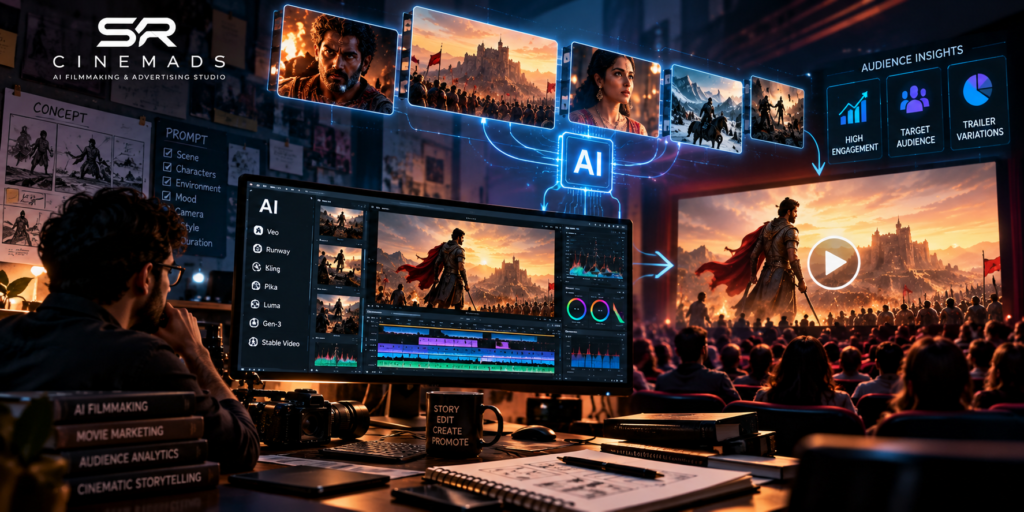
AI-Powered Movie Trailers: Can AI Predict Audience Excitement?
Meta Title: AI Movie Trailers: Can AI Predict Audience Excitement?
Meta Description: Discover how AI movie trailers, audience insights, and cinematic storytelling are changing film marketing and helping studios test promotional ideas.
Focus Keyword: AI movie trailers
Secondary Keywords: AI film marketing, movie trailer production, AI filmmaking, film promotion, cinematic trailers, audience engagement, movie marketing strategy
Introduction: The Future of Movie Trailers Is Changing
A great movie trailer can turn an unfamiliar film into a conversation everyone wants to join. A mysterious opening, an unforgettable musical cue, a powerful performance, or a single unexpected reveal can make audiences curious about a story they have never experienced.
But what if filmmakers could use artificial intelligence to explore different trailer concepts, analyse audience reactions, and make more informed creative decisions before a film’s release?
AI movie trailers are opening new possibilities for film marketing. Artificial intelligence can support visual development, editing experiments, audience research, and the creation of promotional variations. Combined with cinematic storytelling, these capabilities may help filmmakers discover new ways to attract attention.
However, an important question remains: can algorithms genuinely predict audience excitement, or is the emotional power of a great trailer still something that human creativity understands best?
The answer lies somewhere between data and storytelling.
What Are AI-Powered Movie Trailers?
AI-powered movie trailers are promotional videos created or enhanced with artificial intelligence tools. These tools can assist filmmakers and marketing teams with different stages of the creative process.
Depending on the workflow, AI can help with:
- Generating trailer concepts and scripts.
- Creating storyboards and visual references.
- Producing selected cinematic shots or environments.
- Exploring different editing rhythms and opening sequences.
- Generating voiceovers and supporting sound elements.
- Creating promotional versions for different audiences.
- Analysing available audience feedback and engagement data.
For example, a science-fiction film could be promoted through a mystery-focused teaser, an action-oriented trailer, and a character-driven version.
Each version would highlight a different aspect of the same film. The marketing team could then test these versions with suitable audiences and compare the results.
AI can help create and evaluate these alternatives, but it cannot guarantee which trailer will generate the most excitement or translate that excitement into ticket sales.
Can AI Predict Whether an Audience Will Love a Movie Trailer?
AI can help estimate audience responses, but predicting human emotions accurately is a much more complicated task.
Machine-learning systems can analyse available data, including previous campaign performance, viewing behaviour, survey responses, and audience comments. These signals can help identify patterns that may inform future marketing decisions.
For instance, a marketing team might investigate whether audiences respond more positively to character introductions, action sequences, suspenseful openings, or emotional music.
Yet audience excitement is not a single measurable feeling. A viewer might enjoy a trailer without intending to watch the film. Another viewer might remain quiet online but purchase a cinema ticket on release day.
Research published in Participations examined how audiences engage with movie trailers and found that trailer viewing can be a distinct experience from watching the full film. This is an important reminder that trailer engagement does not automatically equal movie-viewing intent.
Read the research: Watching the Trailer: Researching the Film Trailer Audience.
The practical conclusion is simple: AI can support predictions and experimentation, but it cannot know an audience’s future response with certainty.
5 Ways AI Can Transform Movie Trailer Marketing
1. Testing Different Trailer Openings
The opening moments of a trailer establish its tone and give viewers a reason to keep watching.
A historical epic might open with a sweeping battlefield shot, a close-up of its central character, or a dramatic line of dialogue.
AI-assisted workflows can help teams explore several opening concepts before choosing which ones deserve further development.
The final decision should consider the film’s identity, target audience, genre, and campaign objective rather than visual spectacle alone.
2. Creating Audience-Specific Trailer Versions
Different audience groups may respond to different aspects of a film.
An action-focused audience may be interested in choreography and conflict, while viewers attracted to emotional drama may prefer character relationships and narrative tension.
Academic research on movie-trailer effectiveness has explored how audience characteristics can influence trailer responses.
Read more: The Differential Success of Movie Trailers.
AI can help marketing teams develop and compare creative variations for relevant audience groups. However, personalisation should preserve the film’s true tone and avoid making misleading promises about its content.
3. Exploring Visual Concepts More Efficiently
AI image and video tools can support early visual experimentation.
A filmmaker might explore a futuristic city, a historical fort, an atmospheric forest, or a dramatic science-fiction landscape before committing to a final visual approach.
These generated concepts can help communicate creative direction to editors, producers, and marketing teams.
When footage represents a real film, however, promotional material must distinguish between conceptual imagery and scenes that actually appear in the finished production.
4. Analysing Audience Feedback
Comments, surveys, viewing patterns, and campaign results can provide useful information about how viewers respond to promotional material.
AI-assisted analysis may help organise large amounts of feedback and identify recurring themes, such as interest in a character, confusion about the storyline, or enthusiasm for a particular visual sequence.
But online comments are not a perfect representation of the entire audience. They may be influenced by fan communities, promotional campaigns, platform algorithms, and the people most motivated to comment.
Audience analysis should therefore combine multiple signals rather than treating social-media sentiment as a definitive prediction of box-office performance.
5. Adapting Trailers for Different Platforms
A theatrical trailer, a YouTube teaser, and a vertical Instagram Reel serve different viewing environments.
AI-assisted production can help teams explore shorter edits, different aspect ratios, alternative opening shots, and platform-specific versions.
Each adaptation should maintain the film’s central message while respecting the platform’s format and the expectations of its audience.
The objective is not simply to shorten a trailer. It is to make the story compelling within the time and attention available.
The Science Behind Audience Excitement
Although AI tools are evolving, the underlying principles of effective trailer storytelling remain important.
Curiosity
A trailer should provide enough information to make the story understandable while leaving meaningful questions unanswered.
Too little information can confuse viewers. Too much can remove the mystery that makes them want to watch the film.
Emotional connection
Viewers often connect with characters, relationships, conflicts, and stakes. Impressive visual effects may attract attention, but emotional context can help audiences care about what happens next.
Rhythm and anticipation
Music, editing, pauses, sound design, and scene transitions influence the experience of watching a trailer.
A gradual build followed by a memorable reveal may be more effective for one film than constant high-intensity editing.
Clear expectations
A trailer should communicate the film’s genre and tone accurately.
If a promotional video presents a slow character drama as a nonstop action film, it may attract initial interest but disappoint viewers whose expectations do not match the finished movie.
Research on trailer advertising has examined how trailers influence expectations and how creative elements can affect audience responses. These findings reinforce the importance of aligning promotional storytelling with the film itself.
Explore: The Effects of Film Trailers on Shaping Consumer Expectations.
AI vs Human Creativity: Who Makes the Better Trailer?
The strongest approach is not necessarily AI versus human creativity. It is understanding what each contributes.
| Creative task | Where AI can help | Where human judgement matters |
|---|---|---|
| Concept development | Explore alternative ideas and visual directions | Choose a concept that fits the film |
| Editing | Generate or organise possible variations | Establish rhythm, emotional timing, and narrative clarity |
| Visual creation | Develop selected images, environments, and shots | Maintain continuity and artistic intent |
| Audience analysis | Identify patterns in available data | Interpret context and avoid misleading conclusions |
| Final approval | Support quality checks and workflow efficiency | Protect the film’s identity and approve the final message |
AI can generate alternatives quickly, but a filmmaker or editor must decide which moments deserve attention, which details should remain hidden, and when a scene needs silence rather than spectacle.
A technically impressive trailer can still fail if it does not communicate a compelling reason to watch the movie.
How to Build an AI-Assisted Movie Trailer Campaign
Step 1: Understand the Film
Begin with the film’s genre, central conflict, principal characters, emotional themes, and intended audience.
The trailer should represent the movie accurately while highlighting the elements most likely to interest prospective viewers.
Step 2: Develop a Creative Brief
Define the campaign objective, the intended audience, the desired emotional response, the trailer length, and the platforms where it will appear.
For example, a teaser may aim to create curiosity, while a full trailer may need to communicate more of the storyline and establish the film’s appeal.
Step 3: Create a Storyboard
Map out the opening hook, character introduction, escalating conflict, memorable visual moments, and closing reveal.
AI-generated storyboards can help explore visual options, but every sequence should have a clear narrative purpose.
Step 4: Produce and Edit Creative Variations
Use appropriate AI tools and conventional editing methods to develop alternative versions.
Preserve approved footage, check the rights associated with assets, and review generated visuals carefully. For real films, avoid presenting fabricated scenes as authentic footage from the production.
Step 5: Test With the Right Audience
Where practical, test trailer variations with relevant viewers before a major campaign launch.
Useful questions include:
- Did the opening capture attention?
- Was the film’s genre clear?
- Which moment was most memorable?
- Did viewers understand the central conflict?
- Would they consider watching the film?
Combine qualitative feedback with available engagement and viewing data. A small test can provide useful direction, but it cannot guarantee the performance of a full release.
Step 6: Measure the Campaign
Evaluate performance according to the campaign objective.
Potential metrics include video retention, completion rate, engagement, trailer shares, search interest, ticket-page visits, and ticket purchases where reliable data are available.
Use these results to refine the campaign rather than assuming that a high view count automatically indicates commercial success.
What This Means for Independent Filmmakers and Small Studios
AI-assisted workflows could offer independent filmmakers additional ways to explore promotional concepts without committing immediately to every production expense.
A filmmaker might use generated storyboards to develop a teaser, test different narrative approaches, or create supporting promotional assets for digital platforms.
However, AI is not a substitute for every aspect of filmmaking. Complex character performances, authentic production footage, licensed music, professional sound, and detailed editing may still require substantial human work and investment.
The most useful approach is to identify specific production tasks where AI provides genuine value, then combine those capabilities with human creative direction.
For independent studios, this can make creative experimentation more flexible while preserving the importance of storytelling and quality control.
How SR Cinemads Connects AI Filmmaking With Cinematic Advertising
At SR Cinemads, we explore how AI-assisted filmmaking and cinematic storytelling can be applied to advertising, promotional videos, and brand communication.
The creative principles behind a memorable movie trailer also have applications in commercial advertising: a strong opening, visual progression, emotional relevance, and a clear final message.
For example, an automotive advertisement can build anticipation through carefully selected shots, controlled pacing, dramatic sound design, and a memorable product reveal.
A product commercial can use a similar approach to turn a simple demonstration into a more engaging visual story.
Our focus is on exploring creative concepts that connect technology with the fundamentals of visual storytelling.
Discover our approach in AI-Powered Cinematic Advertising for Modern Brands, or visit the SR Cinemads website to explore our creative direction.
Frequently Asked Questions
Can AI create an entire movie trailer?
AI tools can assist with generating visual material, editing ideas, voiceovers, and other trailer elements. A complete, release-ready trailer may still require human direction, licensed assets, editing, sound design, and quality control.
Can AI predict a movie’s box-office success?
AI can analyse historical data and available audience signals to help estimate potential outcomes. It cannot reliably guarantee box-office results because success also depends on the film, distribution, competition, reviews, release timing, and many other factors.
Does AI make movie trailer production cheaper?
AI may reduce costs for selected tasks, such as concept exploration or certain visual assets. Overall production costs depend on the tools, revisions, licensing, editing, and quality requirements.
Can AI analyse YouTube trailer comments?
AI-assisted tools can help organise comments and identify recurring themes or sentiment. However, comments may not represent the broader audience, so the findings should be interpreted alongside other evidence.
Will AI replace trailer editors?
AI can automate or support parts of the editing workflow, but creative judgement remains important. Editors shape narrative flow, emotional timing, pacing, and the relationship between music and imagery.
How can independent filmmakers use AI for promotion?
Independent filmmakers can explore AI-assisted storyboards, teaser concepts, visual development, and social-media variations. They should verify asset rights, review generated material, and ensure that promotional content accurately represents the finished film.
Conclusion: Algorithms Can Analyse Data, but Stories Create Emotion
AI is creating new opportunities for filmmakers and marketers to explore trailer concepts, examine audience feedback, and adapt promotional content for different platforms.
Yet predicting audience excitement remains an uncertain task. Data can reveal patterns, and experiments can provide useful evidence, but neither can fully explain why a particular character, musical moment, or dramatic reveal resonates with millions of viewers.
The future of movie trailer marketing will likely belong to teams that combine AI-assisted experimentation with human storytelling, responsible production, and thoughtful audience research.
For filmmakers, studios, and brands, the real opportunity is not to replace creativity with algorithms. It is to use technology to explore more possibilities and make better-informed creative decisions.
Ready to Explore Cinematic Storytelling for Your Brand?
At SR Cinemads, we explore AI-powered creative workflows and cinematic advertising concepts designed to help brands communicate through compelling visuals.
Visit srcinemads.com to explore our work and discuss your next cinematic advertising concept.
Sources and Further Reading
- Watching the Trailer: Researching the Film Trailer Audience — University of East Anglia
- The Differential Success of Movie Trailers — Journal of Retailing and Consumer Services
- The Effects of Film Trailers on Shaping Consumer Expectations — Journal of Retailing and Consumer Services
- Google Trends — Explore Search Interest
This article is for general educational purposes. AI capabilities, platform policies, and commercial licensing terms may change. Verify current requirements before using generated assets in a public campaign.