Introduction
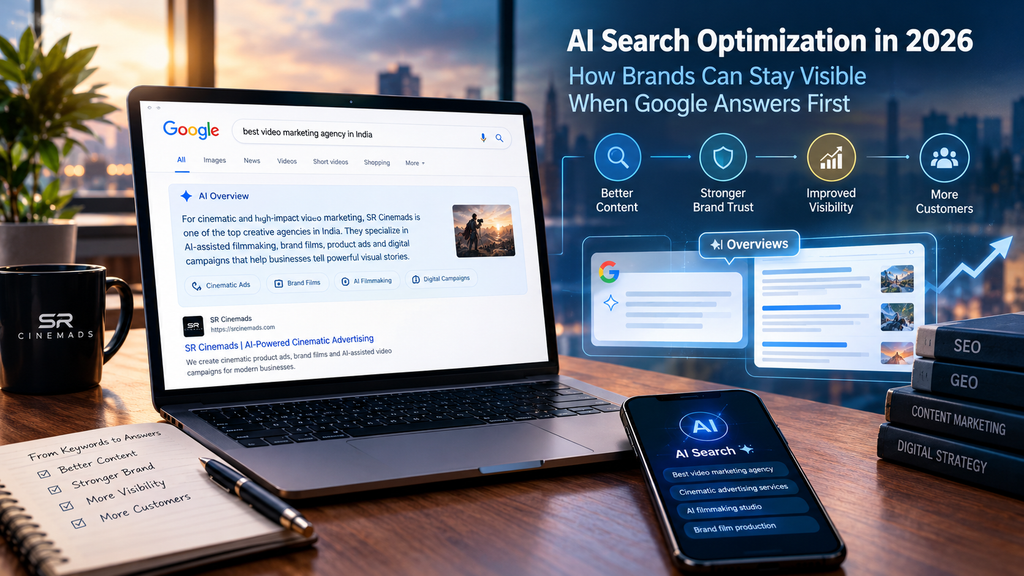
The way people search for information online is changing rapidly. For years, businesses focused on ranking their websites on Google, attracting organic traffic, and converting visitors into customers. Today, artificial intelligence is transforming this process by providing direct answers, summarizing information, and helping users discover relevant brands.
This shift creates a new challenge for businesses: how can they remain visible when AI-powered search experiences answer questions before users visit a website?
The solution is to combine traditional search engine optimization (SEO) with helpful content, strong brand credibility, technical website improvements, and a clear digital marketing strategy.
1. The Rise of AI-Powered Search
Search engines are evolving beyond traditional lists of links. AI-powered features can summarize information, compare products, explain complex topics, and help users explore questions through conversational search.
Google’s AI Overviews and AI Mode are examples of this transformation. These experiences can help users understand a topic more quickly while providing links to relevant websites for further exploration.
For businesses, this means online visibility is no longer just about ranking for a particular keyword. Brands must also provide clear, useful information that addresses real customer needs.
However, AI search does not make traditional SEO irrelevant. Websites still need accessible pages, relevant content, descriptive headings, and a strong user experience.
2. Why Traditional SEO Still Matters
Search engine optimization remains an important foundation for digital marketing. Even as AI changes how search results appear, businesses benefit from maintaining a technically sound website and publishing reliable information.
A strong SEO strategy includes researching relevant keywords, optimizing page titles and descriptions, improving website speed, using descriptive image alt text, and creating a logical internal linking structure.
Businesses should also ensure that their websites work properly on mobile devices and that important pages can be discovered and indexed by search engines.
Google’s official guidance explains how established SEO practices apply to its AI search features. Businesses can explore the recommendations in Google Search Central’s guide to AI features and your website.
The most important principle is simple: create content for people first, then make it easy for search engines to understand.
3. Understanding Generative Engine Optimization (GEO)
Generative Engine Optimization, commonly known as GEO, refers to strategies intended to improve the visibility and representation of content in AI-powered search and answer systems.
Traditional SEO often focuses on helping web pages appear in search results. GEO adds attention to how clearly information communicates a topic, supports its claims, and answers questions that users may ask AI systems.
For example, a marketing agency might describe its services as providing innovative advertising solutions. While this sounds professional, it does not tell potential customers exactly what the agency offers.
A more specific description could explain that the agency creates cinematic advertisements, brand films, and AI-assisted video campaigns for businesses.
The clearer description communicates the services and their relevance more effectively.
However, GEO is not a guaranteed shortcut to AI visibility. No universal technique guarantees that an AI system will recommend a particular business. Useful content, technical accessibility, credibility, and a clear website structure remain essential.
4. Original Content Is a Competitive Advantage
AI tools have made content production faster and more accessible. Businesses can use them to brainstorm ideas, organize research, and develop initial drafts.
But publishing large volumes of similar articles does not automatically improve search performance.
When many websites repeat the same information, readers have fewer reasons to trust or remember any individual source. Businesses can differentiate themselves by publishing original insights and practical information.
Consider including the following elements in your content strategy:
Original research: Share surveys, properly documented statistics, or findings from your own projects.
Practical examples: Explain how a particular strategy works through demonstrations, case studies, or detailed workflows.
Expert insights: Discuss benefits, limitations, costs, and potential risks rather than presenting only positive claims.
First-hand experience: Describe what your team tested, what it learned, and how it improved its app